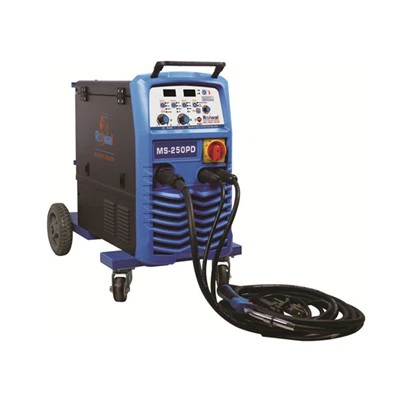
When it comes to the world of welding, the MMA (Manual Metal Arc) welding machine stands as a stalwart tool, widely used across various industries for its simplicity, versatility, and reliability. As a long – standing supplier of MMA welding machines, I’ve received numerous inquiries from customers about the power consumption of these machines. In this blog, I aim to shed light on this crucial aspect, providing you with a comprehensive understanding of what affects the power consumption of an MMA welding machine and how it impacts your operations. MMA Welding Machine
Understanding the Basics of MMA Welding
Before delving into power consumption, it’s essential to understand how an MMA welding machine works. MMA welding, also known as stick welding, involves using a consumable electrode coated in flux. When an electric current is passed through the electrode, an arc is formed between the electrode and the workpiece. The heat generated by this arc melts the electrode and the base metal, creating a weld joint.
The power source for an MMA welding machine is typically an electrical supply, which can be either single – phase or three – phase depending on the machine’s size and application requirements. The machine must maintain a stable arc during the welding process, and the power it consumes is directly related to this function.
Factors Affecting Power Consumption
Welding Current
One of the most significant factors influencing the power consumption of an MMA welding machine is the welding current. The welding current is measured in amperes (A) and determines the heat input into the weld. Higher welding currents produce more heat, allowing for deeper penetration and faster welding speeds. However, they also result in increased power consumption.
For example, a small – scale MMA welding machine might operate at a current range of 20 – 100 A, while larger industrial machines can handle currents up to 600 A or more. As the current increases, the power consumption rises exponentially. This is because power (P) in an electrical circuit is calculated using the formula (P = VI), where (V) is the voltage and (I) is the current. In MMA welding, the voltage remains relatively stable within a certain range, so an increase in current directly leads to an increase in power.
Duty Cycle
The duty cycle is another crucial factor that affects power consumption. The duty cycle of a welding machine is defined as the percentage of time within a 10 – minute period that the machine can operate at a given amperage without overheating. For instance, a machine with a 60% duty cycle at 200 A can operate continuously for 6 minutes out of every 10 minutes at that amperage.
A higher duty cycle means the machine can run for longer periods without interruption, but it also implies higher power consumption. Machines with lower duty cycles may consume less power overall, but they need to be operated intermittently to prevent overheating. When choosing an MMA welding machine, it’s important to consider the duty cycle based on your specific welding requirements. If you need to perform continuous welding for extended periods, a machine with a higher duty cycle will be more suitable, even though it may consume more power.
Electrode Size and Type
The size and type of the electrode used in MMA welding also play a role in power consumption. Larger electrodes require more current to maintain the arc, which in turn increases power consumption. For example, a 6 mm electrode will generally need a higher current compared to a 3.2 mm electrode.
Different electrode types also have varying power requirements. Some electrodes are designed for specific applications, such as welding high – strength steels or working in difficult environments. These specialized electrodes may require more power to achieve the desired weld quality.
Welding Technique
The welding technique employed by the operator can significantly impact power consumption. A skilled welder who can maintain a stable arc and use the appropriate travel speed and electrode angle will consume less power compared to an inexperienced welder. For example, if the arc length is too long, the machine will need to supply more power to maintain the arc, leading to increased power consumption. Similarly, a slow travel speed can result in excessive heat input and higher power usage.
Calculating Power Consumption
To calculate the power consumption of an MMA welding machine, you need to know the welding current, voltage, and the duration of the welding operation. The formula for calculating power is (P = VI), where (P) is power in watts (W), (V) is voltage in volts (V), and (I) is current in amperes (A).
Let’s assume we have an MMA welding machine operating at a voltage of 25 V and a current of 150 A. Using the formula, the power consumption ((P)) is (P=25\times150 = 3750) W. If the welding operation lasts for 30 minutes (or 0.5 hours), the energy consumption ((E)) can be calculated using the formula (E = Pt), where (t) is time in hours. So, (E=3750\times0.5 = 1875) watt – hours or 1.875 kilowatt – hours (kWh).
It’s important to note that these calculations are based on ideal conditions. In real – world scenarios, factors such as the machine’s efficiency, fluctuations in the electrical supply, and the actual welding process can affect the power and energy consumption.
Impact of Power Consumption on Operations
The power consumption of an MMA welding machine has several implications for your operations. Firstly, it directly affects your electricity costs. Higher power consumption means higher energy bills, which can significantly impact your bottom line, especially if you have a large – scale welding operation.
Secondly, power consumption can influence the choice of welding equipment. If you are working in a location with limited power supply, you may need to choose a machine with lower power requirements. On the other hand, if you need to perform heavy – duty welding tasks, a more powerful machine may be necessary, even though it will consume more power.
Lastly, power consumption is related to the environmental impact of your welding operations. As the world becomes more conscious of energy efficiency and reducing carbon emissions, choosing a welding machine with lower power consumption can contribute to a more sustainable operation.
How Our MMA Welding Machines Address Power Consumption
As a supplier of MMA welding machines, we understand the importance of power consumption for our customers. That’s why we have developed a range of machines that are designed to be energy – efficient without compromising on performance.
Our machines are equipped with advanced technology that allows for precise control of the welding current and voltage. This ensures that the machine consumes only the necessary amount of power during the welding process. For example, our inverter – based MMA welding machines are known for their high efficiency, as they can convert the input power more effectively compared to traditional transformer – based machines.
We also offer a variety of models with different duty cycles and power ratings to meet the diverse needs of our customers. Whether you are a small – scale workshop or a large industrial facility, we have a machine that can provide the right balance between power consumption and welding performance.
Conclusion

In conclusion, the power consumption of an MMA welding machine is influenced by several factors, including welding current, duty cycle, electrode size and type, and welding technique. Understanding these factors is crucial for optimizing your welding operations, reducing energy costs, and making an informed decision when choosing a welding machine.
Deep Well Submersible Pump As a supplier, we are committed to providing our customers with high – quality MMA welding machines that are not only reliable and versatile but also energy – efficient. If you are in the market for an MMA welding machine and want to learn more about our products and how they can meet your power consumption requirements, we encourage you to get in touch with us. Our team of experts is ready to assist you in selecting the right machine for your specific needs and to answer any questions you may have.
References
- American Welding Society. (2022). Welding Handbook.
- O’Neill, B. (2019). Welding Technology: Principles and Applications.
Lewei Pumps Industry Co., Ltd.
Lewei Pumps Industry Co., Ltd. is one of the most professional mma welding machine manufacturers and suppliers in China, featured by quality products and low price. Please rest assured to buy bulk discount mma welding machine for sale here and get free sample from our factory. Also, customized service is available.
Address: Shanshi Industrial Zone, Daxi Town, Wenling City, Zhejiang Province, China
E-mail: info@rolwal.com
WebSite: https://www.rolwalpumpweld.com/
