If you’ve ever visited a bakery, a craft brewery, or a facility packaging fresh produce, you know that even the most industrial equipment has to meet strict standards when it comes to food safety. As a Ruiqi Air Compressor supplier, I get this question all the time: “Can Ruiqi air compressors really be used for food-grade applications?” It’s not a trivial ask—using the wrong compressor can lead to contaminated products, regulatory fines, or even health risks for consumers. Let’s break this down with the kind of practical, science-backed details you’d expect from someone who’s spent years helping food and beverage businesses choose the right equipment. Ruiqi Air Compressor
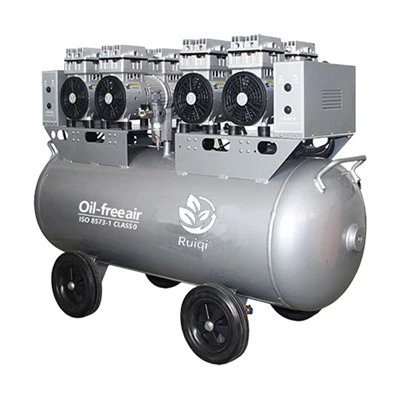
First, let’s clear up a common misconception: air compressors don’t automatically qualify as food-grade. It’s not just about the brand name—it’s about how the compressor is designed, built, and maintained. Food-grade compressed air isn’t just clean; it’s free of oil, moisture, and particulates that could mix with the product. For example, in a winery, compressed air is often used to move grape juice through pipes. If that air has even a tiny amount of compressor oil, it can ruin the batch or make it unsafe to drink. In a meat processing plant, air used to convey packaged cuts must not have any microbial contaminants.
So where do Ruiqi air compressors fit in here? Ruiqi has two main lines of compressors that are worth discussing for food settings: oil-injected screw compressors with food-grade oil, and oil-free scroll compressors. Let’s start with the oil-injected models. These use a special lubricant that’s formulated to meet food safety standards—not the standard industrial oil you’d find in a construction compressor. Ruiqi’s food-grade lubricants are tested to comply with FDA 21 CFR 178.3570, which regulates lubricants that come into contact with food. That’s a big deal because it means if there’s ever a tiny, unavoidable leak of oil into the air stream, it won’t contaminate the product. But here’s the catch: even with food-grade oil, an oil-injected compressor needs a high-quality filtration system to remove any residual oil, moisture, or dust before the air reaches the food processing line. Ruiqi offers integrated air treatment packages—coalescing filters, desiccant dryers, and carbon filters—that are designed specifically for this purpose. These aren’t afterthoughts; they’re engineered to work with Ruiqi’s compressors to reduce oil carryover to less than 0.01 parts per million (ppm), which is the threshold most food and beverage facilities require.
On the other hand, Ruiqi’s oil-free compressors take this a step further. These models don’t use any lubricants in the compression chamber at all. That eliminates the risk of oil contamination entirely, which makes them ideal for applications where even trace amounts of oil are unacceptable. Think of a pharmaceutical facility that uses compressed air to fill syringes, or a dairy plant that aerates yogurt. Ruiqi’s oil-free scroll compressors are built with precision-machined components that don’t require lubrication in the air end, so the compressed air is essentially free of oils, fats, and other hydrocarbons. They also meet ISO 8573-1 Class 0, which is the international gold standard for oil-free compressed air. That certification means there’s zero risk of oil carryover, no matter how the compressor is operated or maintained.
But design and certification are only half the story. Maintenance is just as critical. As a supplier, I can’t stress this enough—even the best food-grade compressor will fail if it’s not serviced properly. Ruiqi provides detailed maintenance guidelines for their food-grade models, including regular filter replacement, oil analysis (for the oil-injected models), and chamber inspections. For example, in a bakery that uses compressed air to operate dough molders, failing to replace a coalescing filter every 6 months could lead to a buildup of oil in the air stream, which would get into the dough and require the batch to be discarded. I’ve seen this happen to small businesses before—it’s not just a financial loss, it’s a threat to their reputation. So when we sell Ruiqi compressors to food facilities, we don’t just hand over the equipment and leave. We work with their maintenance teams to create a schedule that aligns with their production cycles. Some of our clients have a dedicated technician come in every quarter to inspect the compressor, test the air quality, and make adjustments. That’s part of what makes Ruiqi stand out for food applications—they don’t just sell a machine; they provide support to ensure it meets food safety standards long after installation.
Another point to consider is the environment in which the compressor is installed. Food processing plants can be humid, dusty, and sometimes have corrosive substances (like vinegar in a pickling facility or salt in a seafood plant). Ruiqi’s food-grade compressors are built with corrosion-resistant materials, like stainless steel enclosures, to withstand these conditions. That prevents rust or flaking particles from getting into the air stream. I remember a client who runs a craft brewery in Oregon—their plant has high humidity year-round, and their old compressor kept rusting, leading to particulates in the air that would get into their beer lines. We switched them to a Ruiqi food-grade oil-free compressor with a stainless steel enclosure, and since then, they haven’t had a single contamination issue. That’s the kind of real-world impact you can’t get from just looking at a spec sheet.
Now, let’s talk about regulatory compliance. Most food facilities have to follow either FDA regulations (in the U.S.), EFSA guidelines (in the European Union), or other local food safety rules. Ruiqi’s food-grade compressors are tested and certified to meet these standards. For example, the oil-injected models with food-grade oil are registered with the FDA, and the oil-free models have ISO 8573-1 Class 0 certification. That means when a facility gets a routine inspection from a food safety agency, they can provide documentation that their compressed air system is compliant. I’ve had clients tell me that this certification made the difference between passing and failing an inspection. It’s not just about the compressor—it’s about having the paperwork to prove it meets the required standards.
But here’s what I always advise potential customers: don’t just take my word for it. Ask for third-party test results. A lot of suppliers will say their compressor is food-grade, but the proof is in the independent testing. Ruiqi provides these test reports with every food-grade model we sell. We also encourage clients to test their compressed air themselves on a regular basis—there are portable testing kits that can measure oil content, moisture, and particulates. I worked with a client in a frozen food plant who did their own testing and found that even with a Ruiqi compressor, their air had a bit more moisture than needed. We adjusted their desiccant dryer settings and added a secondary moisture filter, and within a month, the tests came back well within the required limits. It’s a collaborative process, not a one-time installation.
Now, let’s address the “but can I use any Ruiqi compressor?” question. The short answer is no. Ruiqi makes industrial compressors that are not designed for food applications—these are the basic models used in construction, metal fabrication, and other non-food settings. These models use standard industrial oil, no food-grade filtration, and aren’t certified for food safety. So it’s crucial to specify that you need a Ruiqi compressor model that’s designated for food-grade applications. When you’re working with a supplier like me, I’ll ask you about your specific application: what’s the compressed air used for (moving product, operating tools, aeration?), what’s the product sensitivity, and what regulatory standards do you need to meet? That helps me recommend the right model and filtration package. For example, a small bakery that uses compressed air for cake decorating might only need an oil-injected Ruiqi model with a basic filtration system, while a large pharmaceutical plant would need an oil-free model with the highest-level filtration and regular air quality testing.
I also want to talk about cost, because I know that’s a big factor for many businesses. Food-grade compressors can be more expensive upfront than standard industrial models, but the long-term savings are significant. If a compressor leads to a product contamination, that can cost thousands of dollars in wasted product, lost revenue, and regulatory fines. I’ve had a client in the snack food industry who had to discard a whole batch of potato chips because their old compressor had oil in the air stream—cost them over $20,000 in a single incident. A Ruiqi food-grade compressor would have prevented that. Plus, Ruiqi’s compressors are energy-efficient, which helps offset the upfront cost over time. The integrated filtration systems are designed to reduce pressure drop, so the compressor doesn’t have to work as hard, saving on electricity bills.
At the end of the day, the question isn’t just “Can Ruiqi air compressors be used for food-grade applications?” It’s “Which Ruiqi compressor is right for my food facility?” Because every application is unique. As a supplier, I’ve helped businesses of all sizes—from small artisanal cheese makers to large cereal processing plants—find the right Ruiqi compressor that meets their food safety needs. We don’t push a one-size-fits-all model; we take the time to understand their operations, their regulatory requirements, and their budget.
If you’re in the food and beverage, pharmaceutical, or any other industry that requires food-grade compressed air, don’t gamble with contamination risks. Ruiqi has the design, certifications, and support to ensure your compressed air is safe for your products. I’m here to walk you through the different models, help you understand the filtration and maintenance requirements, and make sure you choose the right solution for your facility.

For more information and to discuss your specific needs, don’t hesitate to reach out.
Ruiqi Air Compressor References
- Food and Drug Administration. (2023). CFR Title 21, Part 178: Indirect food additives: Adjuvants, production aids, and sanitizers.
- International Organization for Standardization. (2019). ISO 8573-1: Compressed air—Part 1: Contaminants and purity classes.
- European Food Safety Authority. (2022). Scientific opinion on food contact materials: Lubricants for machinery in food processing.
- Ruiqi Compressor Technical Manual. (2023). Food-Grade Compressor Models: Design, Certification, and Maintenance Guidelines.
Suzhou Ruiqi Intelligent Equipment Co., Ltd.
As one of the most professional ruiqi air compressor manufacturers and suppliers in China, we also support custom service. As we have world-leading production equipment and strong manufacturing capabilities, we warmly welcome you to buy high quality ruiqi air compressor made in China here from our factory. Contact us for pricelist.
Address: No. 1729, Zhongshan South Road, Wujiang District, Suzhou City, Jiangsu Province, China, 16th Floor
E-mail: wts476626494@126.com
WebSite: https://www.ruiqicomp.com/
