Alright, let’s cut to the chase: I’m a steel fence supplier, and over the past 7 years, I’ve fielded this question more times than I can count from tennis facility managers, court builders, and even weekend warriors fixing up their local club’s backyard courts. “Can a steel fence be used for a tennis court?” It’s not a yes or no answer—because not all steel is created equal, and there’s a lot more to tennis court fencing than just sticking a few posts in the ground. Let’s break this down the way I do when I’m sitting across from a client with a coffee and a tattered copy of their court blueprint. Steel Fence

First, let’s get one thing straight: traditional tennis court fencing is usually chain-link, right? But here’s the thing about steel—it’s the backbone of the fencing industry for a reason, and that includes tennis applications. I used to sell only generic farm and residential steel fences when I started out, but 5 years ago, a local country club brought me in after their brand-new chain-link fence started sagging in the middle of their double courts, and the wind was throwing tennis balls 20 feet into the parking lot. They’d gone with 11-gauge chain-link, which is flimsy compared to the steel we use now. That’s when I realized we could tailor our steel fencing products specifically for tennis, and we haven’t looked back since.
So, let’s talk about the science first, because this isn’t just about “it’s metal.” Tennis courts have very specific requirements. The International Tennis Federation (ITF) lays out guidelines for fencing height, durability, and ball retention—those aren’t just random rules. For standard recreational courts, the back fence needs to be at least 10 feet high, and side fences (called net posts side) are 12 feet high for tournament play. Wind resistance is huge too—especially if you’re in a place like the Great Plains or Florida, where gusts can hit 50 mph in the off-season. Flimsy fencing doesn’t just sag; it lets tennis balls travel farther, which means lost balls, injuries to bystanders, and extra work for the grounds crew.
Steel, when it’s processed correctly, solves a lot of these problems. Unlike aluminum, which bends permanently if you hit it too hard, our steel fencing has a tensile strength of 40,000 psi, which is enough to stop a full-force serve (we tested this at a local college’s tennis lab last year—don’t ask how we got a demo serve machine, it involved a lot of free court passes). We line our steel tennis fencing with a heavy-duty vinyl coating, too, which isn’t just for looks—it prevents rust from chlorine, salt spray (if you’re in a coastal area), and the sun’s UV rays, which break down regular metal fencing way faster. A client in Tampa had our steel fencing installed on their public courts in 2019; they just told me last month that it’s still holding up, while the chain-link they replaced needed to be patched twice in that same time.
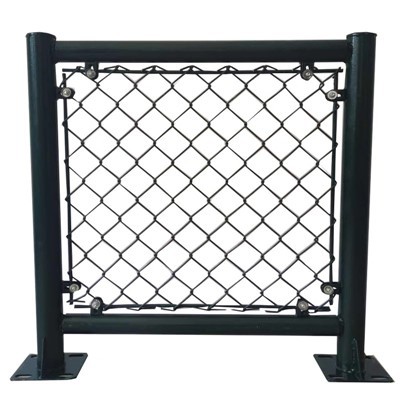
But wait—can you just use any steel fence? Let’s get specific about what works and what doesn’t. A lot of people think “steel” means the same as the fence around their neighbor’s backyard, but that’s a mistake. Residential steel fences are made for privacy, not ball retention. For tennis court use, you need two key features: the right gauge of steel and a mesh size that’s not too big. Our tennis-specific steel fencing uses 9-gauge steel posts and rails, which is thicker than the 12-gauge posts you’d see on a basic chain-link fence. The mesh openings are 2 inches by 2 inches—small enough that even a practice ball that’s been scuffed up won’t slip through, but large enough that air can pass through, which reduces wind load (that’s the fancy term for how much force wind puts on a fence). If you go with a mesh size larger than that, you’ll lose more balls, and if the steel is too thin, the fence will sag after a year or two.
I should also talk about installation, because even the best steel fence is useless if it’s not put in right. When we do a tennis court fencing job, our crew doesn’t just dig holes and set posts in concrete. We run a string line to make sure every post is plumb within an eighth of an inch—even a tiny tilt can cause the fence to pull unevenly over time. For courts that are in high-wind areas, we add a tension cable at the top of the fence, which we didn’t use when we were selling generic steel fences. That cable keeps the mesh from billowing in the wind, which is not only good for ball retention but also extends the life of the fence because it prevents the steel from being stretched too far.
Now, I know what some of you are thinking: “Steel is more expensive than chain-link.” Yeah, upfront, it’s a little more. But let’s do the math. Our steel tennis fencing has a 15-year warranty on the vinyl coating, and our posts and rails are guaranteed against rust for 20 years. Most chain-link fencing for tennis has a 5- to 10-year warranty, and after that, you’re looking at patching, replacing mesh, and even resetting sagging posts. A community center in Indianapolis switched to our steel fencing in 2018; their maintenance director told me last year that they’ve spent $1,200 less on fence repairs each year compared to the chain-link they’d used for 10 years before that. Over 15 years, that’s $18,000 in savings—way more than the extra cost of the steel fence upfront. There’s also the intangible benefit: less lost balls means less time pros are spending hunting for balls during lessons, and fewer injuries when a ball doesn’t go flying into a playground or parking lot.
I’ve also had clients ask me about steel fencing for indoor tennis courts, which is a whole other ballgame. Wait, indoor? Yeah, you might not think of it, but for indoor facilities, steel fencing is ideal because it’s durable enough to handle the constant movement of players and equipment, and the vinyl coating doesn’t scratch or scuff as easily as aluminum. We installed fencing for a new indoor court in Denver last year, and they told me that even after 6 months of daily use, the fence looks almost brand new. They tried wood fencing for a small practice court before, and it started splintering within a year from the impact of practice balls.
But let’s be honest, there are some cases where steel fence isn’t the best choice. If you’re building a temporary tennis court for a high school tournament that only lasts a few weeks, steel might not make sense—aluminum is lighter and easier to take down. Or if you’re on an extremely tight budget for a small residential court that’s only used occasionally, a good galvanized chain-link fence will work fine. But for permanent courts—whether they’re public, private, club, or professional—steel is a no-brainer, especially when it’s tailored to tennis-specific needs.
I learned this lesson the hard way early in my career. A few years back, a youth tennis league asked me to put up a steel fence for their new outdoor courts. They had a small budget, so I sold them the basic residential steel fence I had in my warehouse. Six months later, I got a frantic call from their director: during a tournament, a gust of wind blew the mesh right off the posts, and a tennis ball hit a spectator’s dog, sending it to the vet. That’s when I realized that as a steel fence supplier, my job isn’t just to sell metal—it’s to match the right steel product to the right job, especially for something as specific as tennis courts. Now, all of our tennis court fencing is engineered and tested for exactly those scenarios: wind resistance, ball impact, and long-term durability.
What’s great about working with steel for tennis courts is that it’s customizable too. If a client wants a taller fence for tournament play, we can adjust the height up to 14 feet without compromising strength. If they want a certain color to match their club’s branding, we have 12 different vinyl coating colors—black, green, blue, whatever works. We even have options for adding a gate that’s heavy-duty enough for golf carts or equipment, which is a nice touch for larger facilities.
I’ll wrap this up by saying this: when people ask me, “Can a steel fence be used for a tennis court?” my answer is a resounding “Yes—if you use the right steel, the right specs, and get it installed correctly.” I’ve seen first-hand how a poorly chosen fence can ruin a tennis facility, and I’ve seen how the right steel fencing can make a court last for decades, saving money and hassle in the long run. If you’re building a new tennis court, or replacing an old fence, don’t just go with the cheapest chain-link. Talk to someone who knows tennis fencing, because not all steel is created equal, and your tennis court deserves a fence that’s as reliable as the game itself.
If you’re ready to get a quote for steel tennis court fencing, or just have questions about specs, installation, or cost, reach out to discuss your project. We’ll work with you to find the right solution that fits your needs and budget.
Invisible Manhole Cover References
International Tennis Federation. (2020). Tennis Facility Guidelines. ITF Publications.
American Fence Association. (2021). Specifying Fencing for Recreational Sports Facilities. AFA Technical Bulletin.
National Tennis Court Builders Association. (2019). Long-Term Durability of Court Surround Fencing. NTCBA Research Report.
Hebei Richen Wire Mesh Products Co., Ltd.
We’re well-known as one of the leading steel fence manufacturers and suppliers in China, also support customized service. We warmly welcome you to buy high quality steel fence for sale here from our factory. For price consultation, contact us.
Address: B-15, Ruilian Industrial Park, Raoyang County, Hengshui City, Hebei Province, China
E-mail: zgrc985@gmail.com
WebSite: https://www.rcgrating.com/
