If you’ve ever stood beside a used boom lift on a job site—dust on its outriggers, scuffs on its control panel, hours logged on its digital meter—you know it’s more than just a machine; it’s a workhorse that gets you out of tight spots, whether you’re trimming a 40-foot tree at a residential home, changing lights on a 6-story commercial building, or reaching over a construction trench to fix utility lines. But one question I get more than any other from buyers, renters, and even fellow equipment operators is this: “What’s the steepest slope I can safely drive this thing on?” Used Boom Lift

Let’s cut to the chase: there’s no one-size-fits-all number. But as someone who’s been selling used boom lifts for 12 years, I’ve seen too many operators guess wrong, get themselves into trouble, and even do permanent damage to a machine that could’ve served them for years if they’d just followed the rules. This isn’t about random jargon or factory fine print—this is about real-world use, the kind I deal with every single day when I help customers pick a used lift that fits their job and their site.
First, let’s talk about the science behind slope ratings, because that’s where a lot of people trip up. Most people think slope is measured in degrees, right? A 10-degree slope sounds steep, a 20-degree sounds almost impossible. But manufacturers and OSHA (Occupational Safety and Health Administration) actually use a percentage rating, too. A 10% slope is about 5.7 degrees, a 20% slope is roughly 11.3 degrees, and a 25% slope is around 14 degrees. For context: a standard residential driveway is usually around 10% for accessibility, so a 20% slope is steeper than most private roads.
Now, here’s the key point most used boom lift buyers miss: the maximum slope rating isn’t a single number. It changes depending on what type of boom lift you’re talking about, how much weight is in the basket, whether you’re driving uphill, downhill, or sideways, and even whether you’ve extended the outriggers. Let’s break that down by the two most common types of used boom lifts I sell: articulating (or “knuckle”) boom lifts and telescopic boom lifts.
Articulating boom lifts are the ones with the little hinges in the arm—perfect for getting around obstacles like buildings, power lines, or trees. Most mid-sized used articulating boom lifts (think 40 to 60 foot units) have a published maximum slope rating between 22% and 25% for driving on level terrain. But that’s when three things are true: you’re not carrying more weight than the lift’s rated load (usually 500 to 1,000 pounds in the basket), you’re driving straight uphill or downhill (never sideways—side slopes are a whole different risk), and the surface is stable, not loose dirt, wet grass, or gravel that can shift under the tires.
Telescopic boom lifts, the straight-arm ones built for extra height and reach, are a bit different. Their design is more rigid, so their slope ratings are usually a tiny bit lower. Most 60 to 80 foot telescopic used boom lifts top out around 20% for straight driving, and that number drops even further if you’re carrying a full load. I sold a 2018 Genie S-60 last year to a painting contractor in Ohio, and he told me he thought he could take it up a 22% slope to reach a church steeple. I talked him out of it before he even picked it up—those straight-arm lifts have a higher center of gravity, so a few extra degrees of slope and a full bucket of paint and ladders would’ve put him way over the edge.
But wait—what about outriggers? A lot of new operators think if they deploy the outriggers, they can drive on steeper slopes. That’s a dangerous myth. Outriggers are for when the lift is in the basket position, stationary, for work. They don’t make the machine stable while it’s moving across a slope. In fact, driving on a slope with outriggers deployed puts extra stress on the hydraulic system and the lift’s frame, and I’ve seen at least three used units come back to my shop with bent outrigger mounts because someone tried to do that. If you need to work on steep terrain, you deploy the outriggers first, level the lift completely, then lower the arm into the basket position for work—you never drive with outriggers out.
Now, let’s talk about the factors that change that number from the factory rating to what’s actually safe for your used boom lift. First, surface condition. A slope that’s fine on packed asphalt becomes a hazard on wet mud, loose gravel, or even grass that’s been watered. I had a customer last spring who brought a 2020 JLG 450AJ back because he’d tried to drive it across a 20% slope on a muddy construction site. The tires spun, the machine slid sideways, and he scratched the arm on a pile of lumber. The factory rating said 25% for that lift, but the surface turned it into a 30% effective slope, and that’s when the risk starts. Second, load weight. If you’re carrying two people plus tools and materials in the basket, that’s way more than the rated 500 pounds for a mid-sized articulating lift. I always tell customers: if you’re going to be doing heavy work in the basket, reduce the driving slope by 5% minimum. So if your lift is rated for 25% with a single operator, don’t go over 20% when you’re carrying two people and gear. Third, tire condition. A used boom lift with worn, smooth tires has way less traction than a new unit with deep treads. If the tires are cracking or the tread is less than 2/32 of an inch, I recommend cutting the maximum slope by another 5%—no exceptions.
Here’s where a lot of used boom lift buyers get lucky (or unlucky): factory ratings are conservative, right? Most machines can handle a little more than the printed number, but that doesn’t mean you should push it. I once had a long-time customer who’s a general contractor, he’s been buying lifts from me for years, and he swears he can take a 25% slope on any unit as long as it’s dry. He’s never had an accident, but I’ve seen three other guys try the same thing and end up tipping a lift or rolling it. The problem is, one day the site will be a little wet, or they’ll carry an extra bag of concrete in the basket, and that one time will be the time the machine loses stability. As a used lift supplier, my job isn’t to sell you a machine that “can get the job done” if you take risks—it’s to sell you one that’ll get the job done safely, so you don’t pay for repairs or workers comp down the line.
Another thing to mention is OSHA rules, because that’s non-negotiable. OSHA says that mobile aerial lifts (which is what boom lifts are) must not be operated on slopes steeper than the manufacturer’s rated maximum. If your used boom lift doesn’t have a slope rating label on the frame, that’s a red flag I always point out to buyers. A lot of older used lifts (pre-2000) don’t have clear slope labels, which means the previous owner either removed it, or the label wore off. If that’s the case, I recommend checking the original operator’s manual for the model year, or doing a simple test in a controlled area. How do you test slope safely? Find a flat, clear area, like an empty parking lot, and place wooden blocks or cones to mark a slope. Slowly drive the lift up the slope, keep the basket empty, and stop when you feel the machine start to tilt or the tires lose traction. That’s your real-world maximum slope for that unit, not the factory number. But I always tell customers: if the manual doesn’t have a clear rating, assume the maximum is 15%—that’s the safe fallback.
Wait, what about when you’re positioning the lift at a worksite, not just driving across? A lot of people confuse driving slope with “set-up” slope. When you deploy the outriggers, you can level the lift on a slope that’s a little steeper than the driving limit, right? For example, if you have a slope of 18%, you can deploy the outriggers and level the lift, as long as the outrigger pads are on stable, level ground (or you use pad extensions to level them). But once it’s level, you never extend the arm past a certain point—even a level lift on a 18% slope has a lower reach capacity than a lift on flat ground. That’s another thing to check in the manual: the reach capacity decreases as the slope increases. For example, a 60 foot articulating lift might have a 500 pound capacity on flat ground, but only 300 pounds on a 10% slope, and less than 200 pounds on a 20% slope. That’s a detail I always go over with customers when they look at a used lift, because it’s easy to forget when you’re focused on height and reach.
Now, let’s talk about common mistakes I see with used boom lifts specifically. Older units might have hydraulic systems that aren’t as tight as new ones, so when you’re on a slope, the brakes might not hold as well, or the steering might be less responsive. Newer used lifts (2015 and up) have built-in slope indicators that light up or beep if you’re exceeding the rated slope, which is a huge safety feature. But I always warn buyers not to rely on that indicator alone—those sensors can be worn out or calibrated wrong, especially on used lifts that have been through multiple owners. Do a quick test, check the manual, and don’t push the slope just because the beep hasn’t gone off yet.
Another mistake: driving sideways on slopes. I can’t stress this enough. The maximum slope rating is for straight driving only. If you’re moving sideways across even a 10% slope, you’re putting the lift at extreme risk of tipping over. Sideways movement shifts the center of gravity dramatically, and most boom lifts aren’t designed to handle that kind of lateral weight load. I had a customer last year who tried to move a used articulating lift sideways across a 12% slope, and the basket dropped a few feet when the hydraulic system shifted. Luckily, no one was hurt, but the lift needed $8,000 in repairs for the arm and hydraulic lines. That’s a repair bill that could’ve been avoided if he’d just followed the basic rule: only drive straight uphill or downhill, never sideways, on sloped terrain.
Let’s wrap this up with a practical tip for anyone buying or using a used boom lift. When you’re shopping, ask the supplier for the model-specific slope rating, the year of the lift, and any maintenance records—especially for the hydraulic and brake systems. If the supplier can’t provide that, keep looking. When you’re on a job site, inspect the terrain first: is it stable? Are there any ditches or dips that could make the slope steeper than it looks? Check the weather too—if it’s raining or dewy, cut the slope by 5% minimum, because wet surfaces reduce traction by half or more. And when you’re operating, take it slow. Don’t gun the engine to get up a slope, because that can make the tires spin and cause a skid. Keep the basket empty while driving, only load it once you’ve reached the work position.
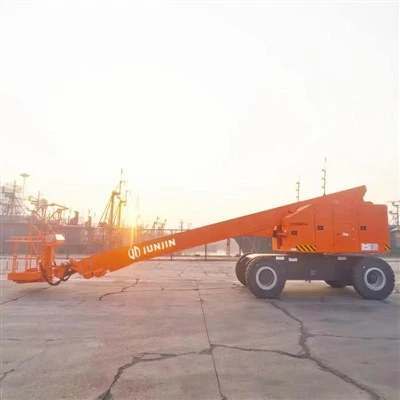
At the end of the day, that’s why I do this: I’ve seen the damage a guess on slope angle can do, to machines, to budgets, and to people. When you’re buying a used boom lift, you’re not just buying a piece of equipment—you’re buying a tool that needs to work with you, safely, for years. If you have questions about a specific used boom lift’s slope rating, or want to talk about finding the right unit for your job site, don’t hesitate to reach out for a conversation. I don’t do hard sells here—just honest advice from someone who’s been in the equipment game long enough to know that safety and reliability beat any “deal” on a lift that’s going to cause problems down the line.
Used Boom Lift References:
- Occupational Safety and Health Administration. 29 CFR 1926.451, Safety Standards for Aerial Lifts. U.S. Department of Labor, 2022.
- Genie Industries. Operator’s Manual for Articulating Boom Lifts (Models Z-45/25, Z-60/37). Terex Corporation, 2019.
- JLG Industries. Safety Guidelines for Operating Mobile Boom Lifts on Sloped Terrain. Oshkosh Corporation, 2021.
- National Safety Council. Equipment Safety: Aerial Lift Operation Best Practices. NSC, 2023.
- International Organization for Standardization. ISO 18878: Mobile Aerial Work Platforms – Stability Requirements and Test Methods. ISO, 2020.
Yantai Quanrui International Trading Co., Ltd.
As one of the most reliable used boom lift manufacturers and suppliers in China, we’re featured by high quality customized products. Please rest assured to buy discount used boom lift made in China here from our factory. Contact us for pricelist and quotation.
Address: No. 278, Sanya Road, Gaotuan Town, Fushan District, Yantai City, Shandong Province, China
E-mail: Info@quanjin1588.com
WebSite: https://www.qr1588.com/
